
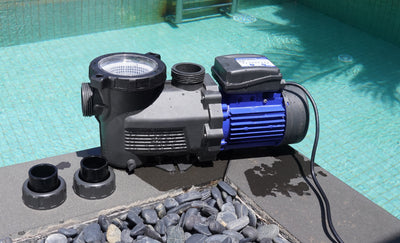


Quick answer: use your pump’s manual before you try to prime it
Priming means getting water into the pump’s wet end and suction path so the pump can move water instead of air. The safe way to approach it is not to copy a generic sequence from a different pump. Start with the exact owner’s manual for your model and use it to confirm whether priming is an owner task for your system. If the manual permits an owner restart, make one careful, model-specific attempt. Stop if you find a damaged cord, a burning smell, repeated loss of prime, a visible leak, a cracked housing, an abnormal noise, or any uncertainty about the electrical setup.
Why one pump can need a different approach than another
Pool pumps do not all sit in the same plumbing arrangement. A flooded-suction system, a pump above the waterline, a system with a heater, or a setup with multiple valves can have different instructions and different failure points. A Pentair self-priming-pump manual, for example, directs owners of a non-flooded-suction system to follow the manual’s water-filling and lid-sealing procedure, while also noting that loss of prime can involve valves, suction conditions, or leaks. That is useful context—not a substitute for the instructions for your pump. Read the model-specific example. The safest habit is simple: treat the pump manual as the procedure and treat general guidance as a checklist for deciding whether you should continue.
Make these no-tools checks before a restart
Before you do anything that changes the system, pause and look for information you can confirm without opening electrical equipment or changing plumbing:
- The pump’s exact make and model from its label.
- The owner’s manual section on priming, startup, and warnings.
- Whether the pool water level is where the manual says it should be for normal operation.
- Whether you can see obvious damage, loose fittings, water around electrical components, or a cracked lid or housing.
- Whether the circulation system was recently opened, winterized, serviced, or reconfigured.
- Whether the pump has been repeatedly losing prime instead of experiencing a one-time interruption.
These observations do not diagnose the fault. They do give you a safer basis for deciding whether a manual-guided restart is appropriate or whether you should call for service.
Use a one-restart boundary
If your exact manual says the priming process is an owner task, keep the attempt narrow:
- Turn the pump off using the normal operating control and follow the manual’s safety instructions.
- Compare the visible setup to the manual before removing any cover or changing any setting.
- Follow only the model’s stated steps for restoring water to the pump/strainer area, reseating a cover, or returning normal operating controls to service.
- Start the pump only as the manual directs and observe from a safe, dry location.
- Stop if water does not begin moving as the manual indicates, if the pump behaves abnormally, or if the same issue returns.
Do not keep cycling the pump in the hope that it will “catch.” A repeated failure to prime can point to a suction-side air leak, a blocked path, an incorrect valve condition, a damaged seal, or a system problem that is not visible from the equipment pad.
Keep electrical questions out of a priming checklist
Pumps, filters, and vacuums are electrical pool equipment, and wet surfaces increase shock risk. The U.S. Consumer Product Safety Commission specifically identifies those risks around pools. Review the CPSC guidance. Do not alter wiring, grounding, bonding, breakers, switches, or protective devices to make a pump restart. If the problem involves power, a tripping breaker, a damaged cord, tingling, smoke, or water near electrical components, stop and use a qualified professional.
When a service call is the useful next step
A good service request includes more than “the pump will not prime.” Record:
| What to record | Why it helps |
|---|---|
| Pump make and model | Lets the technician use the correct manual and parts reference |
| What changed before the problem | Separates a new fault from recent service, winterizing, or a plumbing change |
| What you observed | Helps identify repeat loss of prime, leaks, noise, or power-related symptoms |
| Photos from a safe distance | Gives context without requiring you to disassemble equipment |
| The manual section you followed | Shows which model-specific checks have already been completed |
For a symptom-first checklist when the pump will not run at all, see Pool Pump Won’t Start? Safe Checks Before You Call for Service.
The takeaway
Priming is not a universal pour-water-and-restart task. Use the exact manual for your pump, make one careful attempt only when that manual permits it, and stop when the issue points beyond a visible, model-guided check. That protects the equipment and gives a service professional the details needed to diagnose the system efficiently.

About the author