
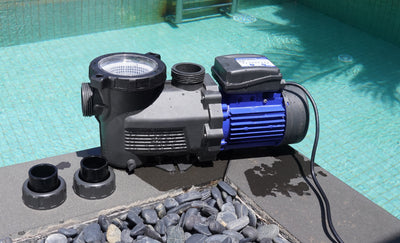


Quick answer: start with conditions, then verify the result
There is no single daily runtime that fits every home pool. The practical starting point is to combine your equipment manual with what your pool is doing right now: how heavily it is being used, how much debris it is collecting, which features are running, and what your water tests show. A longer schedule is not automatically better, and a shorter schedule is not automatically a problem. The goal is to keep circulation and filtration aligned with your pool’s needs while staying inside the limits of the installed equipment.
Do not let pump hours stand in for water care
Pump runtime is one part of pool care. It cannot tell you, by itself, whether sanitizer and pH are where they need to be. The CDC advises residential pool owners to regularly check chlorine concentration and pH. That matters because swimmer load, sunlight, debris, and other conditions can change the water even when the pump is running. Review the CDC’s home-pool guidance. So use runtime and water testing together:
- If the water tests and appearance are stable, keep recording what is working.
- If use, heat, debris, or weather changes, review the schedule rather than assuming yesterday’s plan still fits.
- If water chemistry is outside the recommended range, address the treatment issue. Adding pump hours is not a substitute for following safe water-care guidance.
Build a starting schedule from five questions
Before choosing a number of hours, answer these questions.
1. What is the pump doing during each cycle?
Filtration, a pressure cleaner, a water feature, and heating support can place different demands on a circulation system. ENERGY STAR notes that pool-pump speed requirements vary by function and that pumps with adjustable speeds can be programmed to match the job. See the ENERGY STAR overview. Write down which functions run through the main circulation pump and when they are normally used. If a cleaner or feature has its own instructions, follow those instructions rather than borrowing a schedule from a different setup.
2. How much water and flow are involved?
Pool volume and actual system flow help frame the conversation. Turnover time can be expressed as: `turnover time = pool volume ÷ actual system flow` That relationship is useful for organizing inputs, but it is not a universal homeowner target. The actual flow depends on the installed plumbing, filter condition, valves, and equipment. California’s residential compliance manual uses the same relationship to define turnover time; this article uses it as a planning concept, not a local-code claim. Read the definition. If you do not know the pool volume or installed flow, start by collecting the equipment records instead of guessing from the motor label.
3. What changed this week?
A schedule that worked during a quiet week may need review after:
- Heavy swimmer use or a backyard gathering.
- Wind, leaves, pollen, or a storm.
- A change in water temperature or season.
- A cleaner, heater, or water feature being used more often.
- A dirty filter, reduced return flow, or a recurring circulation symptom.
Treat these as prompts to test the water, inspect the system, and review the manual—not as an automatic instruction to run the pump continuously.
4. Is the schedule spread through the day?
Timers can be helpful because they let you repeat a documented routine. ENERGY STAR gives an example showing that several shorter cycles can help address debris throughout the day while reducing filtration time compared with continuous operation. The example is not a universal six-hour recommendation. Your own schedule must still reflect your pool, equipment, local requirements, and water-test results. See the timer discussion. If your controller offers programming, use only the modes and limits described in the exact owner’s manual.
5. Are you trying to solve a separate system problem?
Cloudy water, weak returns, repeated loss of prime, or a pump that will not start can point to a maintenance or system issue. Changing runtime may not solve it. Before extending a schedule, check the simple, visible items your manual permits: water level, skimmer basket, pump basket, valve position, and filter-maintenance status. If the problem involves electrical equipment, wiring, bonding, breakers, or a persistent circulation fault, stop and get qualified help.
Use a simple review card
Keep this card with your pool records:
| Review item | What to record |
|---|---|
| Water tests | Chlorine and pH results, plus the date |
| Pool use | Quiet day, normal use, heavy use, or event |
| Debris/weather | Leaves, pollen, wind, rain, or storm recovery |
| Equipment function | Filtration only, cleaner, heater support, or feature |
| System observations | Return flow, filter condition, noise, leaks, or alerts |
| Manual limit | The exact manufacturer instruction that applies |
The benefit is not a perfect number on day one. It is a record that helps you make a smaller, safer adjustment and see whether the pool responds.
Know when to stop adjusting runtime
Pause the schedule experiment and involve a pool professional when you have repeated loss of circulation, unexplained pressure changes, persistent water-quality problems, a suspected leak, or any electrical concern. Pumps and filters are electric pool equipment in a wet environment; do not attempt wiring, grounding, bonding, breaker, or protective-device work yourself. Read the CPSC safety guidance.
A better schedule is one you can explain
Start with verified equipment documentation, watch the pool conditions, test the water, and make documented adjustments. That is more useful—and safer—than copying a fixed schedule from another pool. If you are changing a pump as part of the process, use our pool-pump replacement fit checks to collect the compatibility details before comparing models.

About the author