
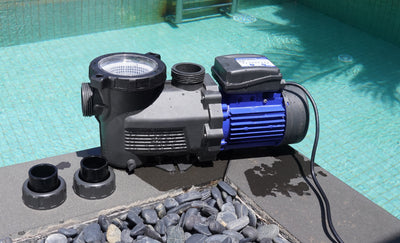


Sometimes, but only if the instructions for your exact cover and your exact pump allow the setup. A utility pump's ability to move water does not tell you whether its base can rest on a cover, whether its intake will avoid the fabric, or whether it will stop before running dry. If either manual is silent or restrictive, ask the manufacturer or use the cover pump specified for that cover. Do not treat a pool-draining utility pump as an automatic substitute for a pool-cover pump.
The practical way to decide is to check two documents together: the cover manual tells you what may sit on the cover; the pump manual tells you how that model must be supported, powered, and monitored. The five checks below turn that comparison into a clear decision.
Start with the cover, not the pump
Identify whether you have a solid cover, a mesh cover, a solid cover with drain panels, or a motorized automatic cover. Their water-removal instructions can differ. For example, LOOP-LOC directs owners of its solid covers without drain panels to use an automatic cover pump, while its mesh covers let rain and snowmelt pass through. That is guidance for those covers, not permission to place any pump on every solid cover. LOOP-LOC cover care and cover comparison.
Find your cover model's instructions for pump placement, surface load, fabric contact, hose routing, and pool water level. If the cover is torn, poorly supported, or collecting water in an unexpected spot, address that problem with the cover maker or a pool professional before adding a pump. Never step onto the cover to place equipment; LOOP-LOC specifically warns against walking on its covers. LOOP-LOC cover care.
Make the five-point pump-and-cover fit check
- Cover support and pump footprint. Does the cover maker permit a pump at that location, and does the pump maker permit the base to rest on that surface? A purpose-built example, the WAYNE WAPC250, uses its supplied debris strainer as a stable contact base; its manual says the strainer helps protect the cover. That feature cannot be assumed for a utility pump with a different base. WAYNE WAPC250 manual.
- Intake and shallow-water behavior. Check that the intake cannot be blocked by cover fabric, folds, or leaves. Compare the actual puddle depth with the pump's minimum operating level and its dry-run instructions. The AQUASTRONG ESU050PM manual requires stable placement and an unobstructed suction base, and specifies a minimum suction water level. It does not identify direct pool-cover placement as an approved application. That missing approval is a reason to confirm fit, not to infer it.
- How the pump starts and stops. A manual utility pump needs someone to watch it and shut it off according to its instructions. An automatic cover pump may respond to water level, but its trigger depth and behavior are model-specific. The WAYNE WAPC250 manual, for example, gives its own start depth and automatic shutoff behavior. Read your model's manual instead of assuming that every pump will stop at the same puddle depth. WAYNE WAPC250 manual.
- Hose and discharge route. The hose must reach an allowed drainage point without kinking, pulling the pump off balance, or pinching at the pool edge. Follow your cover maker's route and local drainage rules. Do not let discharge run back onto the cover or toward the house. A Cover-Pools manual shows how closely its hose routing is tied to its particular cover and supplied pump; copy only instructions that apply to your model. Cover-Pools owner’s manual.
- Electrical setup. Use the protected outlet and cord arrangement required by the pump and cover instructions. Place the pump while unplugged, keep hands and footing dry, and disconnect power before touching or cleaning it. Stop if a cord, plug, switch, or outlet is damaged, or if the needed outlet arrangement is unclear. The CPSC identifies wet surfaces and pool electrical equipment as shock hazards; the WAYNE manual calls for a grounded GFCI outlet for its cover pump. Have a qualified electrician address electrical defects.
If all five checks have support in both sets of instructions, follow those exact instructions and monitor the first run. If you cannot verify one of them, pause and contact the cover or pump maker with both model numbers. A homemade pad, screen, or float setup is not proof that a previously unapproved pump is now compatible.
When a dedicated cover pump is the clearer choice
A cover pump is designed around the cover-water task. Model-specific features may include a broad debris strainer, a stable base, a rope for positioning, and automatic sensing. The WAYNE WAPC250 manual documents these features for that pump. Choose according to your cover maker's allowed equipment and the pump's actual instructions, not the highest advertised gallons per hour.
A utility pump may be useful for a different job, such as removing water from a pool or low area, without being approved to sit on a cover. Our utility-pump selection guide explains flow, lift, hose size, and control mode for pool draining. For a cover-specific choice, see automatic versus manual cover pumps.
Watch the cover and the pool water level
After any permitted setup, check that the pump stays upright, the intake and hose remain clear, and water is actually leaving the intended surface. Watch the pool water level as well. LOOP-LOC warns that on its solid covers, water can seep up through seams when the cover contacts pool water; a running cover pump may then remove pool water rather than just rain or snowmelt. Follow your own cover's water-level limits, and stop if the level is falling unexpectedly. LOOP-LOC cover care.
For a step-by-step look at clearing standing water once the equipment is confirmed, use our winter pool-cover water-removal guide. Keep children and pets away from the covered pool and do not walk onto the cover to reach the pump.
Next check: take the cover model and pump model to their manuals. If either document does not answer whether that pump can rest and operate on that cover, ask the manufacturer before placing it there.

About the author