
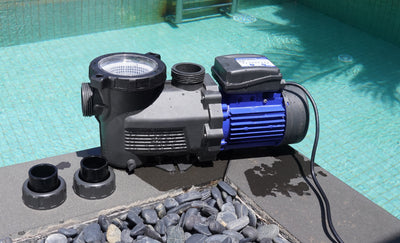


A utility pump can make a messy poolside job much easier. But the biggest GPH number on the box is not enough to tell you whether the pump will work for your yard, your hose route, or your drainage plan. Before you compare models, write down five things: how much water you are moving, how high it has to go, how far the hose will run, where the water is allowed to discharge, and whether you will stay nearby to supervise it. That short list turns a vague shopping decision into a real-world pump choice.
First, be clear about the job
Removing a small amount of rainwater or standing water is not the same as draining a pool on purpose. If you are dealing with water after a storm, a utility pump may be part of a simple cleanup job. If you are thinking about lowering or fully draining a pool, stop and check the pool maker's instructions and get qualified local guidance first. Full-drain decisions can involve structural, liner, groundwater, and local-rule concerns that a pump-shopping guide cannot settle. The discharge destination matters, too. The EPA advises that chemically treated pool water should not be sent to storm sewers or surface waters without an appropriate approach, and local rules vary. In plain terms: decide where the water is allowed to go before you buy a pump or unroll a hose.
Use this five-minute pump worksheet
You do not need a complicated spreadsheet. Grab a note on your phone and answer these five questions.
| Write this down | Why it changes your pump choice |
|---|---|
| How much water is there? | Shallow standing water, cover water, and a larger planned removal are different jobs |
| How high must the water travel? | Vertical lift affects how much flow a pump can deliver |
| How does the hose run? | Extra distance, bends, and uphill sections can change the working conditions |
| Where will the water go? | The route must be allowed locally and stay under control while the pump runs |
| Will you watch the job? | This helps you decide whether a float-switch feature is useful and how much supervision is still needed |
Once you have those answers, product pages become easier to read. You are no longer asking, “Which pump has the highest number?” You are asking, “Which documented pump fits this job?”
GPH gets attention. Head lift decides the real comparison.
Maximum GPH is easy to spot. It is also easy to misunderstand. A centrifugal pump's delivered flow changes with the head it has to overcome. The U.S. Department of Energy explains that the manufacturer’s head-flow curve is the right document for matching a pump to operating conditions. That is general pump guidance, not a promise about any one product. Here is the homeowner version: a pump may move water quickly in an easy, low-lift setup. The same pump can move less water when it has to push uphill or through a longer, more restrictive hose route. So, when you compare pumps:
- Estimate the vertical rise from the water surface to the highest point in the discharge path.
- Note the hose length, bends, and fittings.
- Find the exact model's head-flow curve or performance table.
- Look at the flow shown for conditions close to your job.
- Treat that number as a comparison point, not a guaranteed drain time.
Buying tip: If you cannot find a usable manual or head-flow curve for a model, you do not have enough information for a confident GPH comparison.
Hose size and route are part of the job
A pump and a hose work as one system. A hose that is too small, kinked, damaged, or routed in a way that keeps moving can create a frustrating setup even when the pump itself is a good fit. Before you order, confirm the exact pump's discharge-port details, acceptable hose or adapter information, and any manual limits. Do not force a connection because it “almost fits.” Then walk the route in your yard. Can the hose stay in place? Will people trip over it? Does it cross a walkway or pinch under a gate? Can the outlet shift into a place where the water should not go? These are simple questions, but they are often the difference between a smooth cleanup and a wet mess.
Decide how much supervision you really want
A float switch can sound like a set-it-and-forget-it feature. It is not. On some jobs, a float may help the pump respond as the water level changes. But the behavior, operating range, and limits are specific to the model. Read the exact manual before you rely on it. For a short, attended water-removal job, standing nearby may be the better plan. You can watch the hose, confirm the water is going to the approved destination, and stop the pump if the setup changes. For a longer job, a float feature may be worth considering—but only after you have confirmed how it works on that exact pump. It does not replace a stable hose, a safe discharge route, or common sense.
Do not treat the outlet and discharge route as an afterthought
Pool water may have been chemically treated. That is why the route needs to be decided before the equipment is plugged in. Check with the local utility, stormwater authority, and HOA if it applies to your property. Do not assume a curb, storm drain, ditch, pond, or nearby waterway is automatically acceptable. The EPA guidance above is a reminder to verify the local path, not a one-size-fits-all disposal rule. Keep the hose outlet where you can see it. A hose can move. Soil can erode. Water can travel farther than expected. If you cannot confirm the route or keep the outlet under control, pause the job.
Electrical safety belongs in the buying decision
Water and portable electrical equipment deserve extra care. Use the pump only according to its manual. Keep cords, plugs, and connections out of standing water. Do not use damaged equipment. If conditions are wet, uncertain, or outside the manual, stop and call a qualified electrician or service professional. A GFCI is designed to interrupt power during a ground fault, but OSHA notes that it does not protect against every electrical hazard. Think of it as one layer of protection, not a reason to ignore damaged cords, wet connections, or unclear instructions.
A practical way to compare two pump options
Imagine you want to remove rainwater from a low spot near the pool. The water is not deep, but the hose needs to run across the yard and rise to the approved discharge point. Pump A has a bigger maximum-GPH number. Pump B has a lower headline number, but its manual clearly shows a head-flow curve, port information, and the float-switch details. The better next step is not to guess which one will empty the area faster. Use your lift and hose route to compare the documented information. If Pump A cannot show how it performs at your working conditions, the bigger number is not very helpful. This is the same habit that works for most homeowner equipment purchases: choose the model with the right documented fit, not the loudest headline.
When to pause the project
Stop and get qualified help if:
- you are considering a full-pool drain;
- you cannot confirm where the water may legally go;
- the hose route is unstable or unsafe;
- the pump, cord, plug, or outlet is damaged;
- you need electrical work or have wet electrical connections;
- the manual does not cover your setup; or
- you cannot find the exact specifications needed to compare models.
There is no prize for forcing a pump job to happen today. A short pause is better than guessing about water, power, or property drainage.
Buy for the job you actually have
The best utility pump for pool draining is the one that fits your lift, hose route, approved discharge plan, and supervision needs. GPH matters, but it is only one part of the picture. When you are ready to compare options, look at the exact manual and head-flow curve for the AQUASTRONG or other utility-pump model you are considering. That is where a smart buying decision starts.
Sources used
- U.S. Department of Energy, Improving Pumping System Performance — cited for the general head-flow selection principle.
- EPA: Safely Discharging Chemically Treated Pool Water — cited for local discharge-route caution.
- OSHA: Ground Fault Circuit Interrupters — cited for the limited GFCI safety context.

About the author