
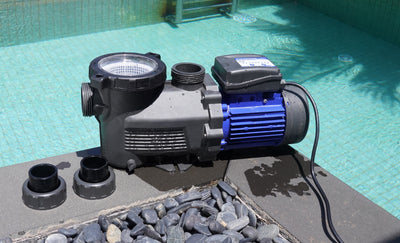


Your utility pump can sound as though it is running while the discharge stays dry. For an AQUASTRONG ESU submersible utility pump, the first safe checks are water level, an open and unkinked discharge line, trapped air, the height of the discharge route, and debris at the inlet. Stop and unplug the pump before handling the hose or pump. If the cord or plug is damaged, an outlet could be flooded, or the fault appears to be inside the pump, stop and seek qualified service.
Start with water and a safe place to work
Look at the water around the pump before trying another run. The intake needs enough water for the specific model to pump. An almost empty container can leave the motor running with no useful discharge. The ESU manuals list water below the minimum level as a cause of no delivery; they also tell users to submerge the pump at an angle to avoid an air cushion beneath it. Check the minimum level in your model's manual rather than borrowing a number from another pump. AQUASTRONG ESU050P manual, pp. 3, 6–7; AQUASTRONG ESU050PM/ESU100PM manual, pp. 3, 6–7.
Switch off and unplug before you reposition the pump. Keep the plug and power connection out of water. Do not pull or lift the pump by its cord or discharge hose. If you cannot reach a dry, safe disconnect point, do not continue the check yourself. ESU050P manual, pp. 3–5.
Check the discharge path before assuming the pump has failed
With power disconnected, follow the hose from the outlet to its end. Is a valve closed? Is the hose pinched behind an object, sharply bent, or blocked at the discharge end? The ESU troubleshooting tables identify a closed or kinked pressure line as a no-delivery cause. Straighten the line and confirm that its outlet is open before a short, attended retry with adequate water. Do not undo a pressurized connection while the pump is running. ESU050P manual, p. 6.
If water appears briefly and then fades, recheck water level and the full hose route. That pattern alone does not identify one fault. An inlet that has become exposed or obstructed, or a line that folds as it fills, may produce a similar symptom. Treat this as a reason to inspect the setup, not as proof that the motor needs repair.
Let trapped air escape using your model's instructions
Air can keep a submerged pump from establishing flow. The ESU manuals mention an air cushion at the underside during placement and air lock in the suction base. They direct users to keep the pressure line open and allow the pump to deaerate through its vent; the manuals for the named ESU models give a limited wait and then a stop/restart step if needed. Follow the exact sequence in your model's manual only when the pump is properly submerged and the power connection is safe. Never keep a pump running with no water merely to “wait out” a suspected air lock. ESU050P manual, pp. 3–4, 6; ESU050PM/ESU100PM manual, pp. 3–4, 6.
If the pump still produces no discharge after one manual-guided attempt, switch it off. Repeated restarts without a change in water level or hose conditions are unlikely to tell you more.
Compare the actual lift with the pump's limit
Trace the discharge route vertically from the water surface to the highest point it must reach. If the installation asks for more lift than the pump is designed to provide, the motor can run without delivering water at the end. The ESU troubleshooting tables list excessive installation head as a no-delivery cause, and their technical tables show that maximum head differs by model. Maximum head is a boundary, not a promise of useful flow at that height. Check the exact model's manual and the route before changing equipment. ESU050P manual, pp. 6–7; ESU050PM/ESU100PM manual, pp. 6–7.
If this is a pool-draining job and you need to evaluate a different pump-and-hose setup, our utility-pump selection guide for pool draining covers that separate planning decision.
Inspect only the accessible inlet
Unplug the pump and look at the outside of its inlet or suction base. Leaves, sediment, or another object can block the water's path in. The ESU manuals name a clogged inlet filter or suction base as a cause of no delivery or reduced flow. Remove accessible debris only as your manual permits, then place the pump on a stable surface where the inlet will remain clear. ESU050P manual, pp. 3, 5–6.
Do not open the housing, reach into the pump, replace an impeller, alter wiring, or bypass a protection device as part of this checklist. The troubleshooting table also mentions an obstructed or damaged impeller, but the manual reserves repair work beyond specified care for qualified specialists. A persistent no-flow condition after the external checks is a service question. ESU050P manual, pp. 3, 5–6.
Know when to stop
Stop immediately if the plug or cord looks damaged, the electrical connection may be wet, the pump repeatedly stops or overheats, the water falls below the model's minimum, or the outlet still stays dry after the safe checks above. Keep the pump off and use your model's manual to describe the symptom to AQUASTRONG support or a qualified pump technician. If the water may contain sewage, chemicals, or another material outside the pump's specified use, do not assume an ordinary utility-pump procedure is suitable. ESU050P manual, pp. 2–3, 5–6.
The useful next step is to identify which external condition changed—water level, hose opening, trapped air, lift, or inlet access—before trying the pump again. That keeps the diagnosis focused and leaves internal faults to service professionals.

About the author