
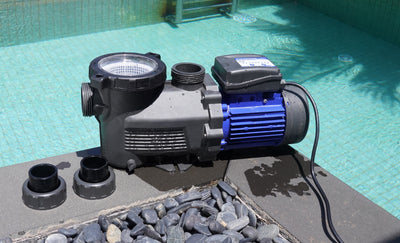


A submersible utility pump can trip a GFCI when current leaks outside its intended electrical path. Possible fault areas include damaged equipment, a damaged cord, or wet electrical connections. The trip alone does not identify which part is responsible. Stop using the pump and keep GFCI protection in place while the problem is assessed. ESFI explains how wet or damaged electrical parts can cause leakage.
The useful checks before service are external observations made after safe disconnection. You do not need to recreate the trip, open the pump, or try another outlet to gather them.
Make the area safe before checking the pump
If there is standing water near outlets, plugs, appliances, or the electrical panel, stay out of it. Do not reach into the water to retrieve the pump or walk through it to reach a switch. If the main power cannot be reached from a dry location, call an electrician to disconnect it. After flooding, have the electrical system checked before power is restored. These precautions follow the CDC's flooded-home guidance.
For an otherwise dry, safely accessible setup, disconnect the pump before any external inspection. Handle only a dry, undamaged plug with dry hands, pulling the plug rather than the cable. If the plug, receptacle, or access route is wet or damaged, leave it alone and obtain qualified help. The AQUASTRONG ESU050PM/ESU100PM manual requires disconnection before servicing and qualified attention to damaged equipment.
A tripped GFCI is not proof that every electrical hazard in the area has been removed.
Identify what actually tripped
A GFCI receptacle usually has TEST and RESET buttons. Its ground-fault function compares current leaving and returning through the circuit. An imbalance causes it to interrupt power. OSHA's GFCI explanation describes that operating principle.
A standard circuit breaker provides overcurrent protection. A breaker with GFCI protection, or a combination device, has additional functions. Read the device label and instructions rather than treating every loss of power as the same fault. As Leviton's GFCI receptacle instructions explain, a GFCI receptacle itself does not protect against circuit overloads or short circuits.
This distinction changes the service question. “The pump stopped” is less useful than “the receptacle's RESET button released” or “the labeled breaker tripped.” Photograph the accessible label from a dry location; do not remove a panel cover.
Check visible condition with the pump disconnected
Keep this inspection limited to what you can safely see. Do not dismantle the housing, open electrical fittings, or probe a receptacle.
Look at the cord, plug, and accessible switch
Check visible sections for cuts, crushed insulation, exposed conductors, damaged plug pins, or an obviously broken switch housing. Note where the cable passes a door, sharp edge, or other pinch point. Leave damaged equipment out of service; tape is not a clearance to use it.
The AQUASTRONG manual specifically calls for checking the cable, plug, and float switch for damage and directs repairs to qualified personnel. An intact-looking exterior still does not establish that the internal electrical insulation is sound.
Record where water reached the connections
Note whether rain, splashing, or rising water reached a plug connection, extension-cord joint, or receptacle. A pump intended for submersion does not make its power connection suitable for immersion. Keep connection locations consistent with the exact model's instructions.
If a GFCI or circuit breaker was submerged in floodwater, do not treat drying and resetting it as a repair. CPSC guidance calls for replacement of flood-submerged protective devices, even when they appear to function. Have an electrician handle that assessment and replacement.
Write down the power arrangement
Was an extension cord, adapter, power strip, or portable protective device already in use? Record its label and the connection locations if safely accessible. This gives the electrician and pump support team context.
Do not improvise an extension-cord size, add adapters, remove a grounding pin, or move the pump to an unprotected outlet. Have the supply arrangement checked against the pump instructions and applicable local electrical requirements.
Use the observations to choose the next service contact
The table below is a handoff framework, not an instruction to reproduce any condition. Use only what happened before you stopped, or what is safely visible afterward.
| Observation already available | What it does—and does not—tell you | Next contact |
|---|---|---|
| The trip occurred when the pump was connected or started. | The timing is useful, but does not locate a fault inside the pump, cord, connection, or supply. | Pump support and a licensed electrician as needed to assess both sides. |
| The trip followed rain, splashing, or rising water. | Record the water exposure. Timing does not prove the motor seal failed or that drying fixed it. | Electrician for exposed supply connections; pump support for equipment assessment. |
| The cord, plug, or switch is visibly damaged. | There is a concrete reason to leave the equipment out of service. | Manufacturer or authorized service; electrician if the receptacle or wiring is also affected. |
| The GFCI would not reset, or had already tripped while the pump was disconnected. | Pump failure is not established. Supply, wiring, other connected equipment, or the protective device need assessment. | Licensed electrician. |
| A protective device was submerged in floodwater. | Apparent operation afterward is not clearance for continued use. | Licensed electrician for replacement and system assessment. |
Failure to reset has several possible explanations. For example, Leviton's SmartlockPro reset lockout can prevent reset when the device cannot provide protection or is not correctly wired and powered. Follow the instructions for the installed device; do not force or repeatedly press RESET.
Send a useful service request without another test run
Prepare this short record:
- Pump model and serial number, plus the manual or purchase information.
- Which protective device operated, including its label and any displayed indication.
- Whether the trip happened on connection, at startup, or after a period of operation.
- Visible damage and any known water exposure at connections.
- The existing power arrangement and other equipment known to share it.
- Photos taken safely while the pump remains disconnected.
“Trip after about ten minutes; plug joint had been splashed; pump now disconnected” gives a technician more to work with than “pump keeps stopping.” Do not reconnect it to improve the description.
Leave insulation testing, leakage measurements, wiring checks, protective-device replacement, and internal pump repairs to qualified professionals. If the electrical issue is resolved and the remaining symptom is a running pump with no discharge, our separate utility pump running but not pumping water guide addresses that different problem.
Considering an AQUASTRONG utility pump after the fault is assessed
If service confirms that replacement is appropriate, we recommend including the AQUASTRONG Utility Pump range in your model-fit review for household drainage. The linked range includes 1/2 HP and 1 HP options, with float-switch availability varying by selection.
Before choosing a variant, match its manual to the water being moved, discharge route, required lift, hose arrangement, switching needs, and available electrical supply. Ask support to confirm anything unclear for the exact model. Replacing a pump does not correct a fault in the receptacle or household wiring.
Review the AQUASTRONG utility pump options and model manuals once the electrical issue has been addressed.

About the author