
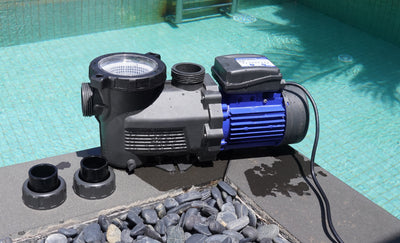


A good pool heat-pump pre-check is not an installation tutorial. It is a way to make the job easier to scope without pretending that every pool, model, electrical service, or local rule is the same.
Start by collecting the facts that can be observed safely. Then put the decisions that depend on the exact model, local requirements, or licensed electrical work in the hands of the people responsible for them. That order protects the install plan from a common failure point: treating a general checklist as a substitute for the current manual.
The AQUASTRONG HEX022 owner's manual is a useful example of why this distinction matters. Its installation section covers location, support, drainage, ventilation, water connections, and model-specific space requirements, while also calling for qualified installation and adjustment to actual conditions. Those details are documentation to check—not universal numbers to copy into every job. Read the manual.
Begin with the exact model and revision
Before anyone discusses a pad, pipe, or circuit, write down:
- The exact model or SKU
- The current owner's or installation manual
- The pool's existing equipment layout
- The homeowner's stated heating goal
- The person responsible for electrical work
- The person who will approve the final installation plan
This is more useful than a generic “heat pump install checklist” because it makes the missing information visible. A manual can contain requirements that change by model, revision, voltage, or configuration. If the model is not confirmed, mark the item as open instead of filling the gap with a category assumption.
If the system is still being selected, pair this packet with a broader pool heat-pump sizing brief. Sizing information and installation information overlap, but they answer different questions.
Record the location as a site fact, not a fit claim
A location note should describe what is there, not declare that the site is already suitable.
Capture these items:
- Access route from delivery point to final location
- Support surface, visible level changes, and how the site handles water
- Service access around the proposed location
- Nearby walls, fences, vegetation, windows, traffic, and other equipment
- The anticipated air path and any obvious recirculation risk
- Where condensate or other site drainage would be considered
- Neighbor and noise context that may affect placement decisions
The exact manual should supply the model's clearance and airflow requirements. Do not use a number from another heat pump—or another revision of the same line—to sign off on the location. A good field note says “manual clearance to verify” beside each side of the unit rather than silently assuming a dimension.
Map the water path before promising compatibility
For a pre-check, the job is to document the existing water path:
- Where water leaves and returns to the pool system
- Visible pipe material and nominal size
- Existing valves, unions, filters, heaters, and bypasses
- Locations that may affect service access or drainage
- Any uncertainty about flow, leaks, or prior modifications
Do not turn these notes into a compatibility promise. Flow requirements, connection options, pipe routing, bypass configuration, and hydraulic effects belong to the exact model documentation and the qualified installation plan. If a pressure, plumbing, or leakage question cannot be answered from visible conditions and current documents, it is a hold point.
Treat electrical information as a handoff, not a DIY step
Electrical work near a pool has a higher consequence than a routine convenience outlet question. CPSC notes that electrical equipment and wiring around pools and spas are part of a shock-risk environment. Review the CPSC electrical-safety context.
A useful pre-check can record the electrical facts that the responsible professional will need, such as the exact model, the visible service location, the proposed equipment location, and any existing documentation. It should not tell the reader how to size a circuit, alter wiring, select protective devices, or determine compliance. Stop and escalate when bonding, grounding, GFCI protection, breaker selection, conductor sizing, disconnects, permitting, or local-code interpretation is involved.
Use a five-part handoff sheet
Before work is scheduled, the completed packet should contain:
- Model document: exact SKU, manual revision, and the requirements still to be verified.
- Site note: access, base, drainage, airflow path, service space, and nearby constraints.
- Water-path note: visible routing and components, with any unknown flow or connection question marked open.
- Electrical handoff: responsible professional, visible site facts, and unresolved code or service questions.
- Owner handoff: expectations, documentation location, and the next decision owner.
This format helps a small installer or service team communicate clearly with the homeowner without making the article sound like a substitute for an on-site assessment.
Know when the pre-check is complete
The pre-check is complete when the unknowns are explicit enough for the next qualified person to resolve them. It is not complete when a checklist has been filled out with guesses.
Pause the job plan when the exact model is missing, the proposed location conflicts with the current manual, the water path is unclear, or electrical scope has not been assigned. Those pauses are useful. They prevent a broad article from becoming an unsafe approval.
Review the current manual for the exact unit and bring this packet to the qualified installer or electrical professional responsible for the work.

About the author