
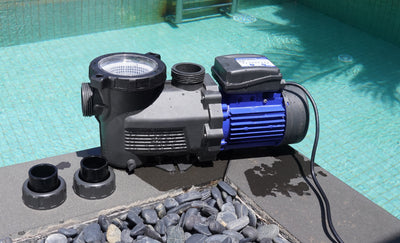


A puddle under a running pool heat pump is often normal condensation, not a plumbing leak. The safer way to tell is to watch when the water appears: while the heater is operating, after the system has rested, and while the circulation pump runs with the heater off. That pattern will not diagnose every problem. It can, however, give you useful evidence without opening the cabinet or touching electrical, refrigeration, or internal plumbing components.
Stop before testing if water and electricity may overlap
Do not approach or operate wet electrical equipment if you see water at an electrical enclosure, submerged controls, exposed or damaged wiring, arcing, smoke, a burning odor, or repeated breaker or GFCI trips. Keep swimmers out of the pool and stay off wet surfaces near the equipment. If you can safely use the normal homeowner controls from a dry position, turn the equipment off according to its manual. Do not open the heat-pump cabinet or reach underneath a wet, energized unit. CPSC identifies pool equipment and wet surfaces as serious electrical-shock hazards and recommends qualified electrical inspection around pools.[\[1\]]When in doubt, stop here and call a qualified pool heat-pump technician or electrician.
Why a pool heat pump can make a surprising amount of water
In heating mode, a pool heat pump pulls heat from outdoor air. As humid air passes across a cold evaporator coil, moisture can condense and drain from the base. Manufacturer guidance notes that condensate is produced while a heat pump operates and generally increases as outdoor humidity rises.[\[2\]]That means puddle size alone is a weak diagnostic clue. A humid day can produce more condensate than a dry day, and different models route drainage differently. AQUASTRONG’s current heat-pump troubleshooting guidance also says that a missing condensate pipe can lead to constant dripping and water accumulation.[\[3\]](https://aquastrong.co/pages/heat-pump-troubleshooting) Use the manual for your exact model to confirm where its condensate connection or drain path should be. Do not copy another brand’s drain location or condensate-volume estimate to your unit.
First, record the water without changing anything
From a dry, stable position, make a quick baseline while the heat pump is operating normally.
- Photograph the puddle and mark its outside edge with chalk or painter’s tape.
- Note whether the compressor/heating cycle is active, not merely whether the display is on.
- Record the weather: humid, dry, raining, or recently raining.
- Check for obvious external sources such as a lawn sprinkler, roof runoff, a nearby hose, filter drainage, or water splashed from the pool.
- Observe where the water first becomes visible: the documented condensate outlet, an exposed union or hose connection, the cabinet base, or an unknown point.
Do not reach under the unit, remove panels, tighten fittings, or put your hand into an area you cannot see.
Run the three-state observation test
The sequence below is adapted from a manufacturer-documented pool heat-pump leak check. It is a general observation pattern, not a replacement for the instructions in your exact model manual.[\[3\]]
State 1: Observe while the heater is operating
Let the heat pump run under its normal settings. Record whether water appears only after the heating cycle begins and whether it emerges from the expected condensate-drain path. Water that tracks heater operation—especially in humid weather—is consistent with condensation. It is not proof that every fitting is leak-free.
State 2: Turn off heat and circulation, then allow a rest period
Using only the normal controls described in your owner’s manual, turn off the heat pump and the circulation system. Allow about one hour for condensate already inside the base to finish draining. Do not use a breaker as a routine on/off control unless the manual instructs you to do so and the area is dry and safe. Do not disturb valves, unions, drain plugs, or wiring during this observation. At the end of the rest period, photograph the puddle again and note whether new water is still appearing. Water that stops is more consistent with condensate. Continued water can also come from trapped drainage, rain, sprinklers, gravity-fed plumbing, or another nearby source, so move to the next state if it is safe.
State 3: Run circulation only while the heater stays off
Start the pool circulation pump while keeping the heat pump’s heating function off. Watch from a dry position. If water starts again or becomes a steady flow only when circulation pressurizes the heater’s water path, a plumbing leak becomes more likely. A Pentair manual uses this same operating-state separation and advises contacting service when water continues steadily with circulation on and the heater off.[\[4\]]Do not continue running the system if the puddle grows quickly, water reaches electrical equipment, the pool level is dropping, or you cannot tell where the water is going.
Read the pattern, not just the puddle
| What you observe | What it suggests | Next step |
|---|---|---|
| Water appears during heating, slows after shutdown, and does not return with circulation only | Condensation is more likely | Confirm the condensate hose or drain path in the exact model manual and keep drainage clear |
| Water returns or continues when circulation runs but heating stays off | A leak in the pressurized pool-water path is more likely | Stop if the flow is significant and arrange qualified service |
| Water appears after rain, roof runoff, sprinkler operation, filter cleaning, or nearby hose use | An external source may be feeding the puddle | Remove the external source and repeat the observation on a dry day |
| Water continues with everything off or emerges from an unknown point under the cabinet | The result is inconclusive; stored condensate, runoff, or a gravity leak may be involved | Do not open the cabinet; send the observation log to service |
| Water reaches electrical parts, controls are submerged, or protection devices trip | Electrical hazard may be present | Keep clear, keep swimmers out, and contact a qualified technician or electrician |
Jandy guidance similarly says water that continues to drain from a heat-pump base after the unit has been off for more than an hour may indicate an internal plumbing leak and should be investigated by a qualified technician.[\[5\]]The exact threshold and drain arrangement remain model-specific.
Use a sanitizer comparison only as a supporting clue
Some manufacturer guidance suggests checking condensate for the absence of chlorine.[\[6\]]Treat that as a secondary clue, not a verdict. If you already use a pool test kit and can collect water without reaching beneath the unit:
- Test a fresh pool-water sample as the control.
- Test a fresh sample from the puddle with the same kit.
- Compare the sanitizer readings.
A puddle sample with no detectable sanitizer while the pool sample has a clear residual is more consistent with condensate. But low pool sanitizer, rain dilution, old strips, sample contamination, or test resolution can blur the difference. A matching result does not locate the leak, and a non-detect does not rule one out. Never taste the water or add dye, chlorine, or another chemical to the heat pump to “prove” its source.
Call service without continuing the test when the risk rises
Stop and arrange service when any of these conditions applies:
- Water reaches the electrical compartment, disconnect, receptacle, cords, or controls.
- A breaker or GFCI trips repeatedly.
- You see damaged wiring, arcing, smoke, or smell overheating.
- The cabinet or controls have been submerged.
- Water forms a strong, steady stream or the pool level is dropping.
- Water returns with circulation only and the source is inside or beneath the cabinet.
- An exposed union, adapter, hose, or pipe is cracked or visibly leaking.
- The unit shows an error that the owner’s manual does not clear with a documented homeowner check.
- You cannot use the normal controls from a dry, safe position.
Electrical, refrigerant, heat-exchanger, and internal-plumbing work belong to qualified service. A visible observation test should never turn into cabinet disassembly.
Give the technician a useful observation log
A short record can help a technician narrow the service call. Include:
- Heat-pump model and serial number.
- Date, time, temperature, humidity, and recent rain or sprinkler activity.
- One photo or short video from each state: heating, rest, and circulation only.
- Where the water first appeared.
- Whether the puddle stopped after about one hour.
- Whether it returned with circulation only.
- Pool-water and puddle sanitizer readings, if you made the optional comparison.
- Any error code, unusual sound, odor, or protection-device trip.
For AQUASTRONG equipment, start with the product-manual library. If the water pattern points to a plumbing leak—or if the result is uncertain—contact AQUASTRONG support or a qualified pool heat-pump technician instead of opening the unit. For related visible checks, see Pool Heat Pump Not Heating? Safe Checks Before You Call for Service and Pool Heat Pump Not Cooling? Safe, Visible Checks Before You Call for Service.

About the author